

There is no single age when it is universally too late to treat short stature. The critical factor is skeletal maturity, not chronological age. A child's growth plates must remain open for height-increasing treatments to be effective. This guide explains how growth plate fusion and bone age assessment determine treatment windows for children. according to Bone age social
Growth Plate Fusion and the Treatment Window
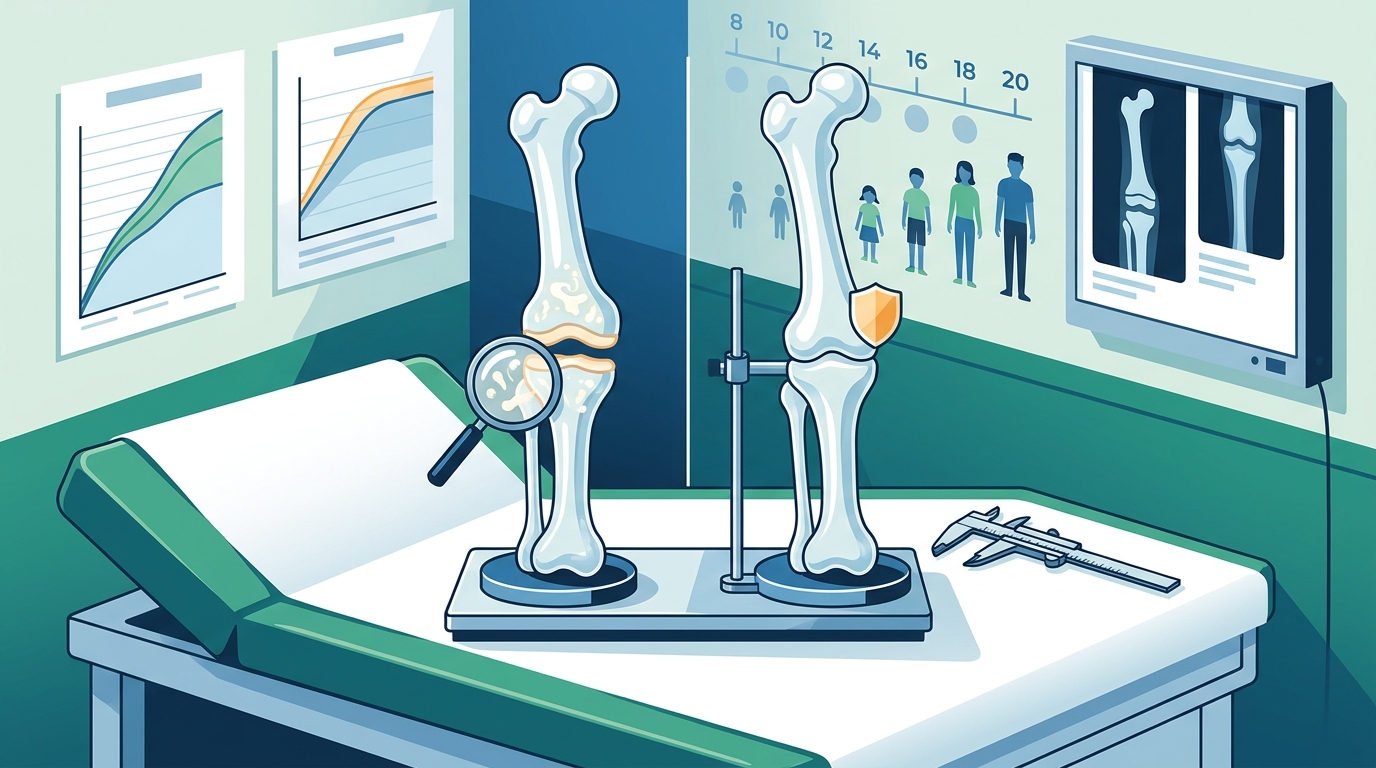
Understanding when growth stops is the first step in evaluating treatment options. Growth plate fusion is the process where the cartilage at the ends of long bones hardens into solid bone, permanently stopping height growth. Once this process is complete, no medication or therapy can increase a child's height. The timing of this fusion varies significantly between individuals, making chronological age a poor predictor of remaining growth potential. according to De novo TANGLED1
Why Chronological Age Is Misleading
Parents often assume that a specific age, such as 14 or 16, marks the end of growth. In reality, two children of the same age can have vastly different amounts of growth remaining. A 14-year-old boy who has not yet entered puberty may have several years of growth left, while a 14-year-old girl who has completed her pubertal growth spurt may have very little remaining. This variability is why medical professionals rely on skeletal markers rather than birthdays to assess growth potential.
The Role of Puberty in Growth Cessation
Puberty is the primary driver of growth plate fusion. Hormones released during puberty, particularly estrogen and testosterone, accelerate bone maturation. In girls, growth typically slows significantly after the onset of menstruation, with most height gain occurring before or shortly after the first period. In boys, the growth spurt often peaks during mid-puberty, and growth continues for a few years after the peak. Understanding where a child sits in this pubertal timeline is essential for determining if treatment is still an option.
When Does Growth Actually Stop?
For most girls, growth plates fuse between ages 14 and 16. For most boys, fusion occurs between ages 16 and 18. However, these are averages, not rules. Some children with constitutional growth delay may have open growth plates well into their late teens, while others with early puberty may fuse earlier. The only way to know for sure is through a clinical assessment of skeletal maturity. At HGH for Children, we emphasize that the question is not "how old is my child?" but "how mature is my child's skeleton?"
Bone Age Assessment: The Key to Timing
Because chronological age is an unreliable indicator of growth potential, clinicians use bone age assessment to estimate skeletal maturity. Bone age is a measure of how mature a child's bones appear compared to standard reference images. It is determined through a simple X-ray of the left hand and wrist, which contains bones that develop in a predictable sequence. according to Bone age social
How Bone Age Is Measured
The X-ray is evaluated using standardized methods, such as the Greulich-Pyle or Tanner-White methods. These methods compare the child's bone images to a reference atlas of bones from children of known ages. If a 12-year-old child's bones look like those of a 10-year-old, their bone age is said to be delayed by two years. This delay suggests that the child's growth plates are still open and that they may have more growth potential than their chronological age implies.
Interpreting Bone Age Results
A delayed bone age is often a positive sign for treatment eligibility. It indicates that the child's skeleton is not yet fully mature, leaving a window for growth hormone therapy or other interventions to be effective. Conversely, a bone age that is advanced or equal to chronological age suggests that the child is closer to completing their growth. Clinicians interpret bone age alongside growth velocity, puberty stage, and family height history to build a complete picture of a child's growth trajectory.
Why Bone Age Matters for Treatment Decisions
Bone age is the single most important factor in determining whether a child is still a candidate for height-increasing treatments. If growth plates are nearly fused, the benefit of treatment is minimal or nonexistent. If growth plates are wide open, there is a significant window for intervention. This is why a bone age X-ray is a standard part of any comprehensive growth evaluation. At HGH for Children, we use bone age assessment to help families understand their child's remaining growth potential and make informed decisions about next steps.
| Factor | What It Indicates | Impact on Treatment |
|---|---|---|
| Chronological Age | Time since birth | Poor predictor of remaining growth |
| Bone Age | Skeletal maturity | Primary determinant of treatment window |
| Puberty Stage | Hormonal development | Accelerates growth plate fusion |
| Growth Velocity | Rate of height gain | Indicates current growth activity |
Key Takeaways
- There is no universal age when it is too late to treat short stature; skeletal maturity is the deciding factor.
- Growth plate fusion permanently stops height growth and cannot be reversed by any treatment.
- Bone age assessment via hand and wrist X-ray is the most reliable way to estimate remaining growth potential.
- A delayed bone age suggests a longer treatment window, while an advanced bone age suggests a shorter one.
- Puberty timing significantly influences when growth plates fuse, with girls typically fusing earlier than boys.
- Comprehensive evaluation should include growth history, bone age, puberty stage, and hormone testing.
- Early assessment is critical, as the treatment window narrows as children approach skeletal maturity.
- Not all children with short stature qualify for treatment; eligibility depends on diagnosis and remaining growth potential.
Frequently Asked Questions
At what age do growth plates close in girls?
For most girls, growth plates fuse between ages 14 and 16. However, this varies based on puberty timing. Girls who start puberty early may fuse earlier, while those with delayed puberty may have open plates into their late teens.
At what age do growth plates close in boys?
For most boys, growth plates fuse between ages 16 and 18. Boys typically have a longer growth window than girls because their pubertal growth spurt occurs later and lasts longer.
Can growth hormone therapy work after puberty?
Growth hormone therapy is generally most effective before or during early puberty. Once growth plates are fully fused, growth hormone cannot increase height. The effectiveness of treatment depends on the degree of remaining skeletal maturity, not just whether puberty has started.
What is a bone age X-ray?
A bone age X-ray is an imaging test of the left hand and wrist used to assess skeletal maturity. It compares the child's bone development to standard reference images to estimate their "bone age," which indicates how much growth potential remains.
Is a delayed bone age always a good sign?
A delayed bone age often indicates more remaining growth potential, which is favorable for treatment. However, it must be interpreted in the context of the child's overall health, growth velocity, and diagnosis. A delayed bone age alone does not guarantee a specific outcome.
How soon should parents seek an evaluation?
Parents should seek an evaluation if they notice their child growing significantly slower than peers, falling off their growth curve, or if puberty seems delayed or advanced. Early assessment allows for timely intervention while the treatment window is still open.
Does being short mean my child needs treatment?
No. Many children are short due to normal genetic variation or constitutional growth delay. Treatment is considered when short stature is due to a medical condition, such as growth hormone deficiency, and when there is sufficient remaining growth potential to benefit from intervention.
Conclusion
Determining if it is too late to treat short stature requires looking beyond a child's birthday. The key lies in assessing skeletal maturity through bone age evaluation and understanding the impact of puberty on growth plate fusion. Early and comprehensive evaluation is the best way to preserve treatment options. If you have concerns about your child's growth, at HGH for Children to schedule a personalized growth assessment.