

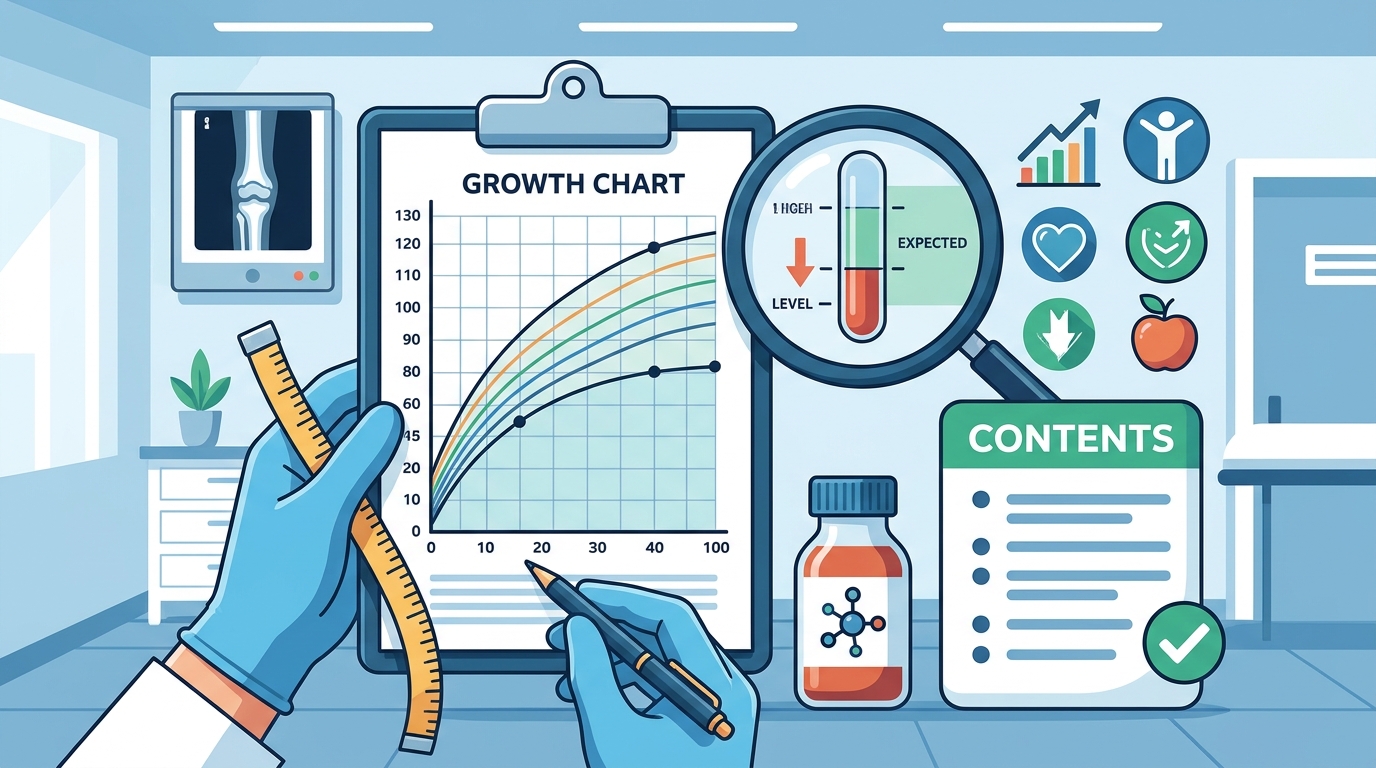
A low IGF-1 level in a child indicates that the liver is producing less Insulin-Like Growth Factor 1 than expected for the child's age and sex. This finding often raises concerns about growth hormone deficiency, but it does not automatically confirm a diagnosis. At HGH for Children, we help families understand that IGF-1 must be interpreted alongside growth velocity, bone age, and overall health to determine the true cause of slow growth.
Understanding IGF-1 and Growth Hormone
Insulin-Like Growth Factor 1 (IGF-1) is a hormone produced primarily by the liver in response to growth hormone (GH). It plays a critical role in childhood growth by stimulating bone development, growth plate activity, and muscle mass. Because IGF-1 levels fluctuate significantly with age, sex, and pubertal stage, there is no single "normal" value for every child. Clinicians use age- and sex-specific reference ranges to interpret results accurately.
Growth hormone itself is produced by the pituitary gland. It stimulates the liver to release IGF-1 into the bloodstream. When growth hormone production is insufficient, IGF-1 levels often drop. However, IGF-1 is also influenced by nutrition, thyroid function, and overall health. Therefore, a low IGF-1 result is a signal to investigate further, not a final diagnosis.
Common Causes of Low IGF-1 in Children
Several factors can lead to low IGF-1 levels in children. Understanding these causes helps parents and clinicians distinguish between normal variation and medical conditions requiring treatment.
Nutritional and Health Factors
Inadequate nutrition or malabsorption can suppress IGF-1 production. Children with gastrointestinal conditions, such as celiac disease, or those with poor caloric intake may present with low IGF-1 levels. Chronic illnesses and thyroid disorders can also impact growth hormone signaling and IGF-1 synthesis.
Constitutional Growth Delay
Constitutional Growth Delay (CDG) is a normal variation in growth where children mature later than their peers. These children often have delayed bone age and may have lower IGF-1 levels relative to their chronological age. They typically experience a later growth spurt and may reach a height consistent with their family background.
Genetic and Hormonal Conditions
Genetic differences in growth and maturation pathways can influence IGF-1 levels. Some children have idiopathic short stature, where they are significantly short without an identified underlying disease. In these cases, IGF-1 may be low, normal, or slightly below the reference range.
Growth Hormone Deficiency and IGF-1
Growth Hormone Deficiency (GHD) occurs when the pituitary gland produces insufficient growth hormone for normal development. GHD is a relatively uncommon cause of short stature, but it is a critical diagnosis to rule out when IGF-1 is low. Children with GHD often exhibit poor growth velocity, delayed bone age, and low IGF-1 levels.
GHD can be congenital, present from birth due to genetic or structural abnormalities, or acquired later due to pituitary damage, tumors, head trauma, surgery, or radiation. Accurate diagnosis requires more than a single blood test. Clinicians must evaluate the child's growth history, physical examination, and specific stimulation tests to confirm GHD. A low IGF-1 level supports the consideration of GHD but does not establish the diagnosis on its own.
How Clinicians Evaluate Low IGF-1
A comprehensive pediatric growth evaluation is essential when a child presents with low IGF-1. At HGH for Children, we use a structured approach to interpret these results in context.
Reviewing Growth History and Velocity
Clinicians review the child's growth charts over time. Growth velocity, or the rate of height gain per year, is more informative than a single height measurement. Generally, children who grow less than 2 inches (5 cm) per year after age 4 may warrant further evaluation. Falling height percentiles combined with low IGF-1 raise the suspicion of an underlying endocrine issue.
Bone Age Assessment
Bone Age is an estimate of skeletal maturity derived from an X-ray of the left hand and wrist. In children with constitutional growth delay, bone age is often delayed, meaning the skeleton is less mature than the child's chronological age. This delay indicates remaining growth potential. In contrast, children with GHD may have delayed bone age but also show other signs of hormonal insufficiency.
Additional Laboratory Testing
When IGF-1 is low, clinicians may order additional tests to rule out other causes. These may include thyroid function tests, celiac disease screening, and insulin-like growth factor binding protein-3 (IGFBP-3). In some cases, growth hormone stimulation tests are performed to assess the pituitary gland's ability to produce growth hormone in response to specific triggers.
| Factor | Constitutional Growth Delay | Growth Hormone Deficiency |
|---|---|---|
| IGF-1 Level | Often low-normal or low | Typically low |
| Bone Age | Delayed (greater than 2 years behind) | Delayed |
| Growth Velocity | Usually normal for stage | Poor (less than 2 inches/year) |
| Family History | Parents were late bloomers | Variable |
| Puberty | Delayed | May be delayed |
Treatment Options and Monitoring
Treatment depends entirely on the underlying cause of the low IGF-1 level. For children with constitutional growth delay, treatment is often not required. These children may need only periodic growth measurements and pubertal monitoring. They often catch up in height during adolescence.
For children with confirmed Growth Hormone Deficiency or other recognized indications, prescription recombinant growth hormone therapy may be appropriate. HGH therapy uses synthetic growth hormone administered through subcutaneous injections. Eligibility and dosing depend on diagnosis, body weight, age, puberty, IGF-1 levels, and medical history. Treatment requires ongoing clinical supervision and regular monitoring of growth response and side effects.
Some children without GHD may qualify for treatment under other recognized indications, such as selected cases of Idiopathic Short Stature or Small for Gestational Age (SGA) with failed catch-up growth. However, being naturally short does not automatically justify HGH treatment. A personalized evaluation is necessary to determine if therapy is appropriate.
Key Takeaways
- Low IGF-1 does not automatically mean Growth Hormone Deficiency.
- IGF-1 levels vary by age, sex, and pubertal stage, requiring specific reference ranges.
- Constitutional Growth Delay is a common cause of low IGF-1 and delayed bone age.
- Growth velocity is a more reliable indicator of growth health than a single height measurement.
- Bone age helps estimate remaining growth potential and skeletal maturity.
- Nutrition, thyroid function, and chronic illness can suppress IGF-1 production.
- HGH therapy is reserved for specific medical diagnoses and requires individualized assessment.
- Comprehensive evaluation by a pediatric growth specialist is essential for accurate diagnosis.
Frequently Asked Questions
What is considered a low IGF-1 level in a child?
There is no single low value for every child. Clinicians use age- and sex-specific reference ranges. A level below the 5th percentile for the child's age and sex is often considered low and warrants further evaluation.
Does low IGF-1 mean my child has Growth Hormone Deficiency?
No. Low IGF-1 can support the consideration of GHD, but it does not establish the diagnosis. Many children have low IGF-1 due to constitutional growth delay, nutrition, or other factors without having GHD.
Can low IGF-1 affect adult height?
The effect depends on the cause. Children with constitutional growth delay may have additional time to grow. Untreated conditions that significantly impair growth velocity may affect adult height potential.
How is low IGF-1 diagnosed?
Diagnosis involves a blood test to measure IGF-1 levels, interpreted alongside growth charts, bone age X-rays, and other laboratory tests. A comprehensive clinical evaluation is required.
Is HGH therapy safe for children with low IGF-1?
HGH therapy is generally safe when used for approved medical indications under medical supervision. However, it is not recommended for children who are simply short or have constitutional growth delay without a qualifying diagnosis.
How long does HGH treatment last?
Treatment duration varies based on the diagnosis and response. It may continue until growth plates close or the child reaches their predicted adult height. Regular monitoring is required throughout treatment.
Where can I find a pediatric growth specialist in California?
HGH for Children offers pediatric growth evaluations in various locations across California, including San Diego, Los Angeles, and Sacramento. Telemedicine options may also be available.
Conclusion
A low IGF-1 level is a significant finding that requires careful interpretation. It is not a diagnosis in itself but a clue that prompts a deeper investigation into the child's growth pattern, skeletal maturity, and overall health. By understanding the difference between normal variations like constitutional growth delay and medical conditions like Growth Hormone Deficiency, parents can make informed decisions about their child's care. At HGH for Children, we provide personalized growth evaluations to help families understand their child's unique development and explore appropriate next steps.
To plan your visit, to schedule a consultation.